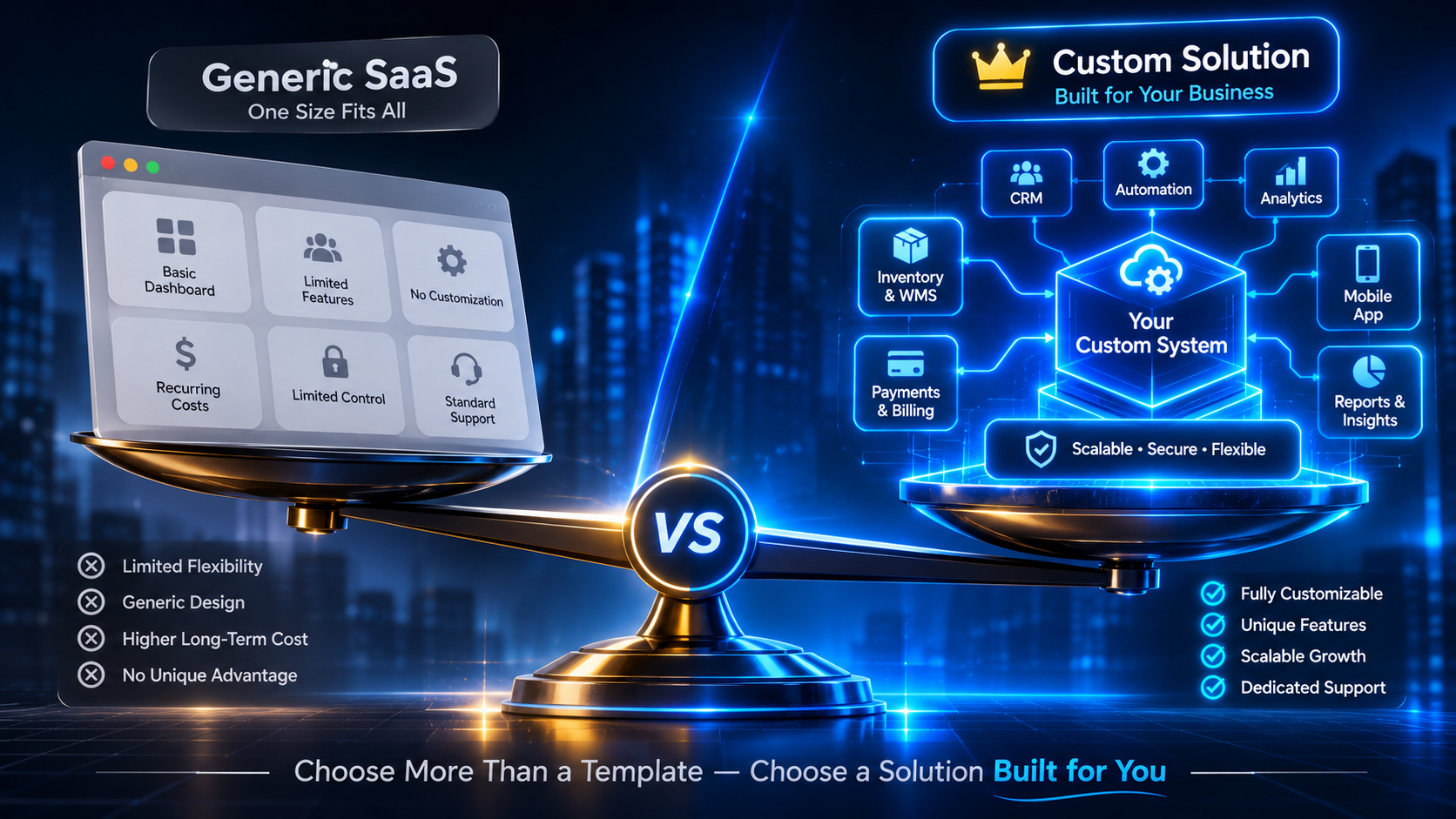
Build vs Buy: Why Smart Businesses Are Choosing Custom Software in 2027
Every business tool you rent is a landlord collecting rent forever. Here is the honest build-vs-buy framework for 2027 — including when SaaS genuinely is the right answer.
The subscription trap nobody totals up
A typical growing business in 2027 rents: CRM, WhatsApp tooling, invoicing, HR or attendance, email marketing, analytics, file storage, maybe an inventory tool. At ₹2,000–5,000 per user per month across stacks, a 15-person company pays ₹4–9 lakh every year — forever — for software that never quite fits how they work.
Over five years that is ₹20–45 lakh in rent, for tools where you own nothing, cannot change the logic, and will lose access to your data the day you stop paying.
What "owning" software actually means in 2027
Self-hosted custom software has crossed a threshold: modern stacks (Next.js, PostgreSQL, Docker on a VPS) are cheap to run, easy to back up, and fully portable. You own the code, the database, the infrastructure credentials, and the data — and you can move hosts anytime.
The build cost that once justified SaaS — six-figure budgets, scarce developers — has collapsed. A focused business system that cost ₹25 lakh in 2019 now costs ₹4–8 lakh, ships in weeks, and runs on ₹5,000/month infrastructure.
When SaaS is genuinely the right answer
Intellectual honesty: buy when the tool is not your differentiator. Accounting, email hosting, payroll compliance, video calls — these are solved problems where SaaS compliance updates are worth the rent.
The line is simple: if the software IS your workflow advantage — how you qualify leads, how your warehouse operates, how your team coordinates — you should own it. If it is a utility everyone uses identically, rent it.
The hidden costs of renting
- Feature bloat you pay for but never use — most teams touch 20% of their SaaS seats’ features.
- Per-seat pricing that punishes growth — adding staff literally costs more every month.
- Workflow mismatch — your team builds spreadsheets and WhatsApp workarounds around the software’s assumptions.
- Data hostage risk — exports are lossy; your history is formatted for their lock-in, not your future.
- Price increases — SaaS vendors raise prices annually because churn is low once you are embedded.
A practical decision framework
Ask three questions per tool: Does it touch our core revenue workflow? Do we pay per seat or per usage in a way that scales badly? Would we be materially hurt if the vendor doubled prices or shut down?
Two or more "yes" answers means start scoping a custom replacement — not all at once, but on a sprint roadmap. Most businesses we work with replace one rented tool every quarter and are fully off rented operations software within 18 months.
The 2027 mindset shift
Custom software used to mean enterprise budgets and IT departments. In 2027 it means a focused sprint: audit your workflow, prototype the screens in a week, build the system in a month, own it forever.
The businesses winning the next decade will not be the ones with the most SaaS subscriptions. They will be the ones whose operations are software they actually own.
Frequently asked questions
Is custom software worth it for a small business?
Yes, if the tool touches your core workflow. A ₹4–8 lakh custom system that replaces ₹3–5 lakh/year in SaaS seats pays for itself in under two years — and then costs only hosting to run.
What if I outgrow my custom software?
That is the point of owning it — you can extend, modify, or rebuild any module. Unlike SaaS, you are never stuck paying for capacity or features you do not need.
How risky is building vs buying?
The real risk is building the wrong scope. Mitigate it with a prototype-first sprint: see clickable screens in days, validate with your team before committing to the full build.
Can I keep using some SaaS alongside custom software?
Absolutely — and you should. Keep utilities like email and accounting on SaaS; own the systems that encode how your business actually makes money.
Building something like this?
Tell us how your business works — we'll design the system around it in a fixed-scope sprint.
Book a free architecture call