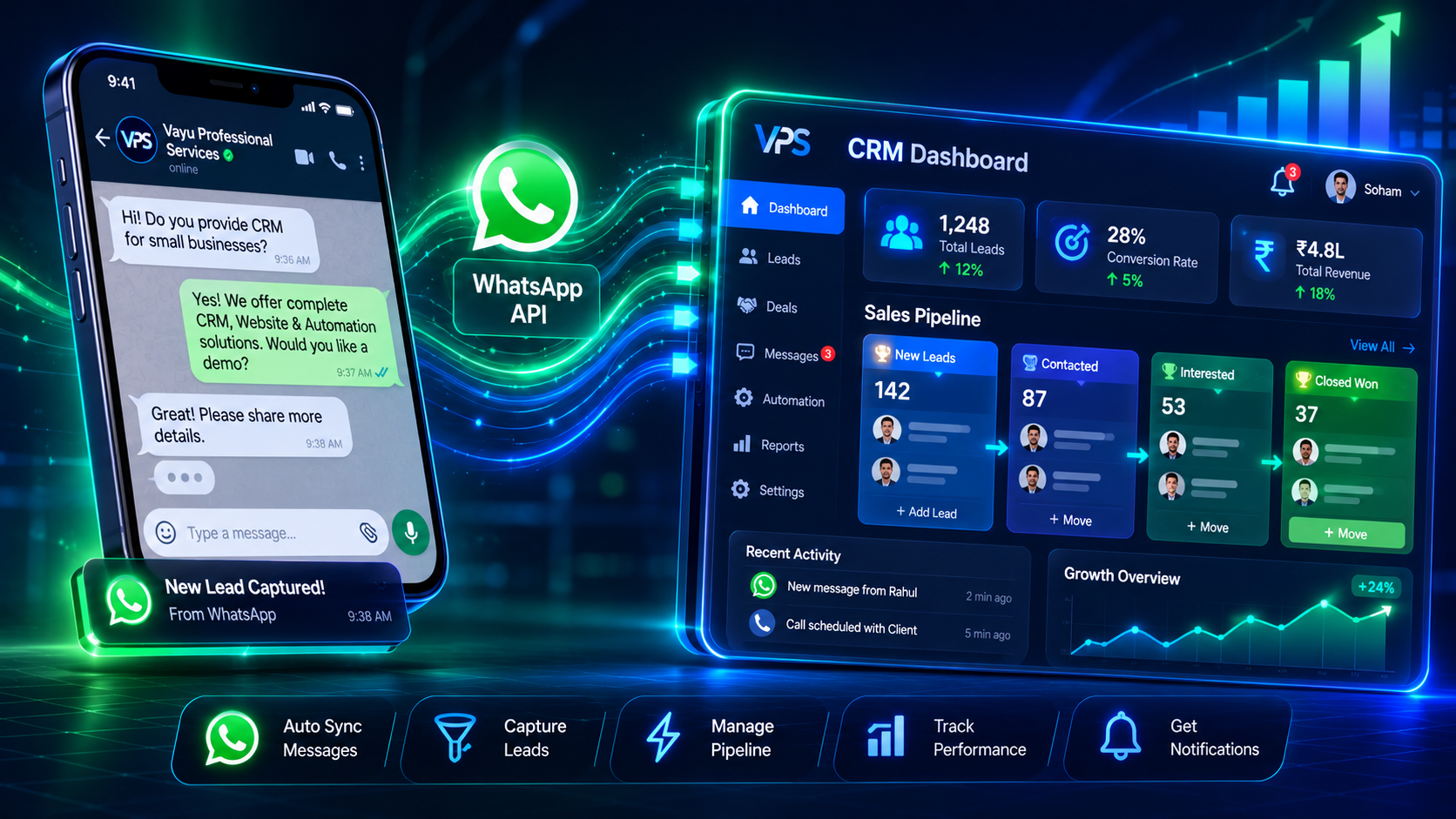
WhatsApp Business API vs Regular WhatsApp: The 2027 Guide for Indian Businesses
Three WhatsApp options, three very different ceilings. Here is how to choose for your business in 2027 — and why the API is where serious operations live.
The three options most businesses confuse
"WhatsApp for business" actually means three different products:
- Regular WhatsApp — the consumer app on a personal number. Fine for chatting, dangerous for business.
- WhatsApp Business app — free, adds catalog, quick replies, labels. Still a manual tool on one phone.
- WhatsApp Business Platform (Cloud API) — the official API for automation: bots, CRM integration, broadcasts, webhooks, multiple agents.
Why regular WhatsApp fails at scale
The moment your business depends on one person’s phone, you have a single point of failure. That phone breaks, the employee leaves, or Meta flags the number for bulk messaging — and every customer conversation history walks out the door.
Worse, regular WhatsApp gives you no automation hooks, no delivery analytics at scale, no CRM logging, and real ban risk when you message customers who did not save your number. In 2027, running sales operations on it is a liability, not a saving.
What the Cloud API actually unlocks
The official API turns WhatsApp into infrastructure:
- CRM integration — every conversation logged against the customer record automatically.
- Automation — instant replies, qualification flows, order updates, payment reminders via approved templates.
- Team inbox — multiple agents on one number with assignment rules, no shared passwords.
- Broadcasts — compliant template messages to opted-in customers at scale.
- Analytics — delivery, read, and response rates per campaign and per agent.
What it costs in 2027
Meta charges per conversation, not per message: marketing conversations cost more than utility or service ones, and service conversations inside the 24-hour window are cheapest. For a typical Indian SMB sending order updates and support replies, realistic spend is a few thousand rupees per month — far less than the staff time manual WhatsApp management costs.
On top of Meta’s fees, you need either a BSP (Business Solution Provider) or a developer to host the integration. Self-hosted or direct Cloud API setups integrated into your own CRM eliminate per-seat BSP fees entirely.
Compliance: the part everyone skips
The API enforces rules that protect your number: you can only message users who opted in, template messages must be pre-approved, and quality ratings drop (then your number gets restricted) if customers block or report you.
This is a feature, not a bug — businesses that collect consent properly and message usefully keep quality ratings green. Those that blast promotions get banned. Build the opt-in flow into your CRM from day one.
Our recommendation by business type
- Solo consultant / under 5 customers a day: WhatsApp Business app is enough for now.
- Growing business with a team: Cloud API + CRM — the team inbox and logging pay for themselves immediately.
- E-commerce, real estate, education, clinics: Cloud API is non-negotiable in 2027 — orders, follow-ups, and reminders belong in the pipeline, not in a chat scroll.
Frequently asked questions
Can I use regular WhatsApp for my business?
Technically yes, but it is risky: no automation, no team access, no CRM logging, and Meta can ban numbers used for bulk/unofficial business messaging. For anything beyond casual chat, use the Business app or Cloud API.
How much does WhatsApp Business API cost?
Meta charges per conversation (marketing, utility, or service categories), typically a few paise to a few rupees each depending on category and volume. Integration costs depend on whether you use a BSP or build directly into your own system.
Can multiple staff use one WhatsApp Business number?
With the Cloud API, yes — multiple agents can handle conversations on one number with assignment rules and full chat history. The regular app and Business app do not support this properly.
Will customers know it is automated?
Conversations are handled by your team or approved automation flows; templates and bot replies are clearly yours. Customers experience fast, consistent service — the API just makes it reliable.
Building something like this?
Tell us how your business works — we'll design the system around it in a fixed-scope sprint.
Book a free architecture call